Showing posts with label Teaching Resources. Show all posts

Monday, 26 May 2014

The new English Lit GCSE


Much of the content of the new GCSE will depend upon how exam boards react to the new official guidance. However, this is what the new guidance actually says the GCSE requires:

 at least one play by Shakespeare
 at least one 19th century novel
 a selection of poetry since 1789, including representative Romantic poetry
 fiction or drama from the British Isles from 1914 onwards.

The Shakespeare requirement is in the existing GCSE and represents no change.

The 19th century novel is not required to be 'British' and names no authors - so all this business about Gove demanding Dickens and Austen is just froth.

The poetry requirement is unlikely materially to affect the balance in composition of poetry anthologies, between 'heritage poetry' (as it is painfully known) and 'contemporary poetry'.

The 20th century drama/prose is required to be 'British Isles' - this could include anything from Scotland and Ireland as well.

It is obviously constructed to exclude mid-20th century American prose. As 90% of pupils study Mice and Men, a novel Gove is known to dislike, it is obvious that Gove is altering requirements to exclude it. But this is no 'narrower' or 'broader' than the present GCSE.

Some other thoughts

I neither endorse nor oppose these changes. I'll work with what I'm required to work with. However, some of the reaction has been quite astonishing.

Labour: 'Michael Gove is putting his own ideological interests ahead of the interests of our children.'

As though Labour were not also motivated by ideology: this is a common trick to depict one's opponents as irrational and oneself as sober and reasonable. Almost every position one could adopt in relation to Education depends upon one's world view, and just as these changes are undoubtedly rooted in ideology, so too are the reasons put forward in opposition.

Labour: 'His vision is backward-looking and preventing the rich, broad and balanced curriculum we need in our schools if our children are to succeed in the future economy.'

This argument derives from economic imperatives, which are not obviously pertinent when it comes to GCSE literature. It has nothing to do with the intrinsic value of different works of literature. It is also unclear why the present situation of three American authors from the mid 20th century is 'forward-looking' or 'broader' than the new requirements which stretch over 200 years and still permit the study of (older) American literature.

As a matter of interest, a book may still exist even if no longer be included on a GCSE syllabus. Schools are still going to be in possession of those books, and will still need something to teach in Year 9. As the new KS3 curriculum requires schools teach 'seminal world literature' it seems likely that these books will still be taught.

This piece from the Guardian is a case study in frenzy, the substance of which is not worthy of engagement. However, the headline is interesting:

To Kill a Mockinbird and Mice and Men axed as Gove orders more Brit Lit

I wonder why To Kill a Mockingbird is receiving equal weight in the reportage? Hardly anyone studies it anymore. Ninety percent of pupils study Steinbeck's novel, not Harper Lee's.

Monday, 17 February 2014

Shakespeare at Key Stage 3: Problems with 'The Tempest'

The story so far...


'I have suffered with those that I saw suffer.'
This term I helped teach The Tempest to Y9. It is a popular choice at this level, largely because it used to be the core text for the now defunct SATs which means English departments have plenty of copies left over. I suspect (though I have not heard anyone say explicitly) that many teachers reckon the subject matter - magic and exile on a strange island - is the kind of thing the pupils could engage with. My other suspicion is that it is a suitable option because it is weightier than a comedy, lighter than a tragedy and, crucially, because it requires no prior knowledge and stands alone, unlike the history plays.

The problems with The Tempest


All of these things are fair enough. However, I could not help but feel that there was something missing. It is possible this be because I have never truly loved The Tempest myself. Certainly it is charming entertainment with lovely moments but it tends toward the realm of ephemera, which I think is visible in the debt it owes to the ephemeral genre of the masque, popular at the time in James' court but forgotten ever after. It just succeeds in pulling back from such an abyss in its handling of the thorny question of colonisation and legitimate authority, but these concepts are difficult and abstract for the literal-minded thirteen-year-old growing up in a stable democracy.

It is also oddly un-poetic. I confess I am overtly treading on the subjective here, and aesthetics are difficult to turn into more than matters of personal taste. However, there is a practical measure to my objection. The first is that aesthetics - sheer beauty - can have a mesmeric effect on the pupils. Such moments as Caliban's speech - one of two poetic high points - had the pupils captivated either when I recited it myself, or when I called upon trusty old Gielgud to do it for me. Moreover, those plays in which Shakespeare more carefully observes the rigours of meter are thereby more fertile plains for teaching iambic pentameter (plus other styles), which besides anything else is something pupils need to know for the poetry and Shakespeare components of the GCSE.

On genre


'Those are pearls that were his eyes.'
Finally, on the matter of genre, there is quite a practical problem with The Tempest: it is a 'romance', not in the Mills & Boon or Hugh Grant sense of the word, but in the ancient (and still current) genre into which we place medieval knights, James Bond and Eliot's The Wasteland. I have not the time (you are not likely to have the patience) to get into details save one feature: romance is characterised by a sequence of minor episodes, each with a minor climax, threaded together by the constant motion of the meandering story. Just think of 007, how many fights and car chases he engages in along the way, how many flights he takes to new and exciting places, how many women he meets as he goes, how many villains...and now compare that with a handful of separate parties scattered across an island, each bumbling along until the final scene. Think of the tempest itself, or Caliban swapping Prospero for Stephano, or Anthonio and Sebastian attempting to murder Alonso, or the two youngsters falling in love, or the masque, or Ariel's banquet, et cetera. Charming entertainment, indeed, and in different guises romance would work wonderfully at Y9, but illuminating the plot for the children is problematic here.

So what?


So I have some issues with using The Tempest in Y9. So what? And I know why I have those issues. Who cares? For surely this is an idle discussion. The department bookshelves have plenty of copies of this play, not so many copies of the others and small prospect of funding for any expansion on unproven, less well known plays, which means I had better buckle down and just work on doing the best I can with The Tempest next year and the year after, et cetera. Right?

Well, maybe wrong. The new KS3 curriculum goes live in September of this year. It stipulates the teaching of not one but two Shakespeare plays. Some departments may already have plenty of copies of something else but which may not be entirely suitable for the 11-13 age bracket, whilst others may not have another play ready to use at all. As a result, it is meet that one reflect upon the strengths and weaknesses of the current core text in deciding where to go with a potential second. Suddenly, the 'so what?' has become a 'now what?'

And I think I have an answer, which I shall share with you another day...

Friday, 8 November 2013

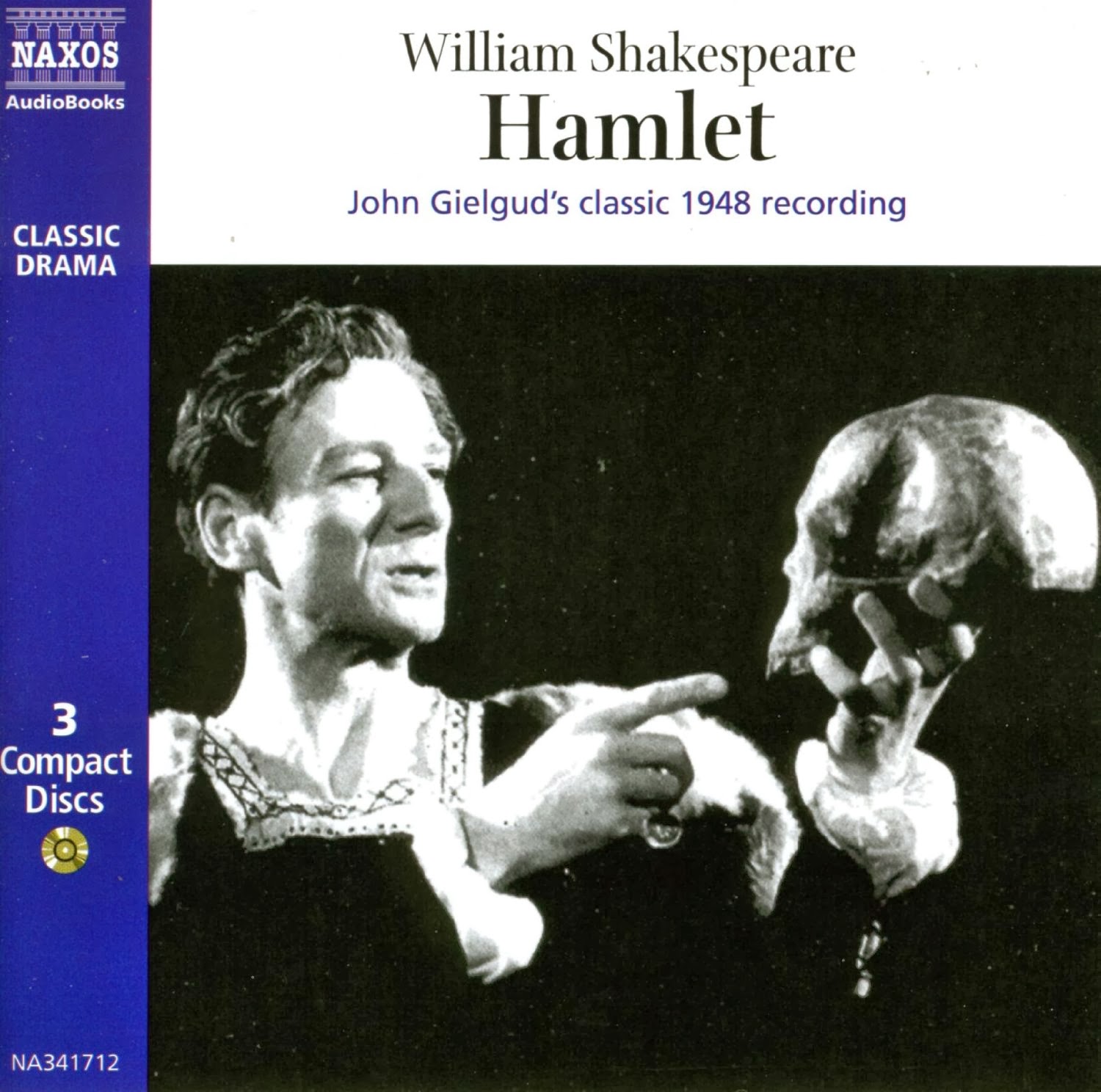
John Gielgud's 1948 Recording of 'Hamlet'


John Gielgud’s Hamlet is probably the greatest of the 20th century. He debuted in 1929, aged just 26, the youngest ever to do so on the West End stage. Over twenty years, he acted the part more than five hundred times, in a number of productions. Most other actors who take the role take it only once.

What made him great? Certainly, his delivery of the lines marks him apart from the rest. Beautiful, mellifluous and astonishingly accurate, he could achieve a speech with greater speed and still sustain greater clarity than other actors could – or can. By way of proof, this 1948 ‘entirety’ recording comes in at three hours and twenty-six minutes, compared with Kenneth Branagh’s ‘full length’ version at a full four hours.

Gielgud understood the lines, the structure of the thoughts and the character that uttered them, the ideas that generate the utterance, the feelings that give the utterance weight. How many Hamlets are slow, ponderous, introspective beings, at odds with the character’s quick wit and nimble mind racing dangerously out of control? Just think of David Tenant choking on ‘to be or not to be’, Mel Gibson staring around the crypt hardly knowing where he is or why, or Olivier slowly whispering private thoughts. (It were best you think not on Branagh at all.) Once you have thought on them, listen to this Gielgud recording and mark the difference.