Showing posts with label London. Show all posts

Sunday, 19 January 2014

The Sunday Post – Biblical Floods, 'Dumbing Down', A Country Jaunt


Reading the Weather


It always amuses me when people claim they can interpret themorality of the weather, but I know it should not amuse me because it is not funny. There is a type of person who thinks they be able to commune with the Almighty in a way the rest of us cannot, reading the signs around us for clues about His will and finding out that – what luck! – the Almighty agreed with them all along! But this is no mere ‘evidence bias’ to which we are accustomed in politics or the media. The UKIP councilor who blamed gays for the fact that we have Winter this year evidently believes he be privy to some knowledge or wisdom that is denied to the rest of us, and which enables him to read clouds. That is rather tragic.

Reading the Media


Not long ago, someone said to me that they thought the reason the media has a problem with teachers is that teachers teach pupils to distrust the media. I dismissed the idea at the time but now I begin to wonder.

All week I have been sifting through material taken from newspapers’ online editions and demonstrating to pupils how vacuous, tendentious and artless is the bulk of media copy. Vacuity and tendentiousness are already well covered in the GCSE so there is little additional work for me to do on that front. However, the question of art matters to me very deeply. A large proportion of media copy is written in appalling style and frequently resorts to cliché and hyperbole, possibly because facts require drama before they can be sold, possibly because hacks need to fill the column inches if they want to get paid. However, besides the morbid pleasure I gain from deconstructing journalese for my pupils, it rouses a genuine anger in me: how often do unlettered hacks attack teachers for ‘dumbing down’?

I tend to be suspicious of the more apocalyptic warnings that literacy is terminally ill. However, it is always appropriate to be vigilant about standards so I take the issue seriously. Rarely (for obvious reasons) does the media turn its focus back upon itself and ask the question: what kind of writing do we think is most readily available and easily accessible to young people these days? It is common enough to complain because children are reading Twilight and not David Copperfield (which is ipso facto the fault of teachers), and it is certainly true that unchallenging literature will do less for a child’s literacy than literature that is challenging. However, do we really believe they read more Twilight than the free content on the web? Novels cost time and money. Comment is FreeRight Minds and Indy Voices cost no money, little time and even less effort to consume (or, to use journalese a moment, it’s ‘dumb’). The greatest exposure to letters that my pupils get is to the same media that has the face to preach to the rest of us about standards.

A Country Jaunt


The weather was good today so I took Fleance* for a spin in the country. I went to see the Cerne Abbas Giant:


There he is, in all his glory:
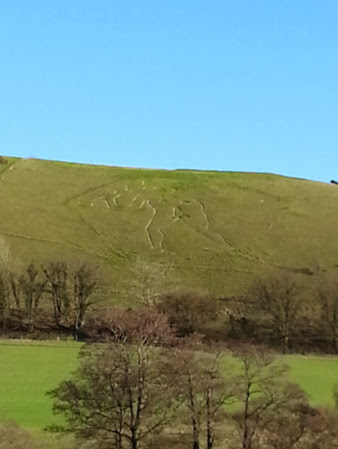


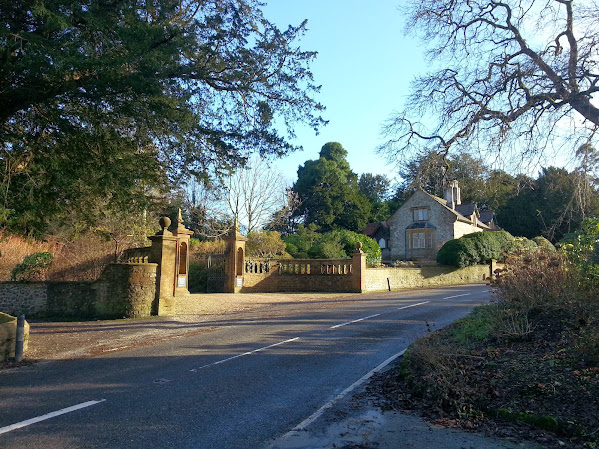
Nearby was a delightful village called Minterne Magna.



Andrew Marr recently wrote in the Spectator that London was being ‘hollowed out’ by exponential price and rent rises and the accumulation of property by foreign speculators. Sebastian Faulks made a similar point in the same magazine, describing the desecration of Notting Hill, with new developments vanquishing the old neighbourhood, paid for with new money. I cannot help but think that if London price out its own, including its nurses, merchants, artists, and young people, there’s an entire England that awaits them, which they could even afford.


*Fleance is the name I give my car.

Subscribe to this blog by email for automatic updates, or follow me on Google+

Wednesday, 10 August 2011

Embattled Old Bill


This is a very tender image, quite literally of two comrades upon the eve of battle, 9th of August 2011. Judging by some of the recent commentary, all that our officers have are each other.

But what do we want fromn the Fuzz? The Guardian has views one may already guess at: that the Coalition is to blame, quoting youths and a youthworker voicing grievance over cuts to services and the behaviour of the police prior to the action:

They cut our youth project by 75%. We used to work with gangs, run a workshop that brought police and young people together. Gone. (1)

This is, of course, precisely what the Guardian wants to push: Government culpability. There are some voices from the street referring to 'cuts', 'Conserva'ives', and 'rich peepol' but nothing that makes a coherent agenda, for there is none. With the exception of Tottenham, these riots are not communities defending themselves, as with Brixton in 1981. Eager not to be seen to condone them as political activists, the Guardian also includes locals who state that penury is no excuse for violence, and that the looters are simply opportunists. However, men like me find it difficult to accept the agenda of a newspaper that expects us to 'understand' the rioters' problems whilst people's homes and livelihoods burn to the ground.

The Telegraph have their own views, which can be guessed at also, expressed it in vociferous headlines which include 'The Long Retreat of Order' and 'Multiculturalists Turned a Blind Eye to Gang Culture'. The following view makes a neat summary:  

The police, bludgeoned by criticism for the way they handled the Brixton riots 30 years ago and the Stephen Lawrence murder in 1994, have become more like social workers than upholders of law and order. (2)

One will immediately note that the examples Philip Johnstone, the writer, provides for us are from a time when the Met was 'institutionally racist' (official verdict). Those riots of 1981 were sparked in a penalised community when a black youth died in Police custody. The Lawrence investigation of 1994 was the biggest shambles in recent CID history, and no one doubted, then as now, that justice would have prevailed had Lawrence been white - I may have been young at the time, but I do remember. Thus, it seems that the Telegraph is chafing at an old gripe here, which men like me had hoped was long buried: why do they have a problem with the Police reaching out to communities? Not only is it effective, it also accords with the right's wistful nostalgia for the days when locals knew by name their local 'bobby on the beat'. As Nick Robinson reminds us, Hestletine berated the Tory right in 1982 for expecting minorities which the state neglected then to go and fight and die for it 8,000 miles due south. It seems the Telegraph never listened.

In amongst this, as Police officers are fighting to protect us, they do so against a backdrop of the right declaring they are just soft social workers and are failing the public (3); the left having damned them for years for being heavy handed and socially insensitive but now declaring they must do more to defend the public; public corruption scandals decapitating their leadership; and imposed redundancies and reviewed pay and conditions. Just now, they are political pawns as the right and the left manoeuvre to appropriate the riots to their own purposes.

I am heartened, however, that in the public at large the Police are not the targets. Though I do not agree with all the criticisms politicians face, I would rather see them face attacks for not doing enough to support the Police, than to see the brave and sometimes injured bobbies berated for doing what we demand of them. This image is especially heartening to me, not only as a former resident of Clapham, but also as a sign that the public know who not to blame.


3) The Daily Mail are espeically bad.

Tuesday, 9 August 2011

Broken Britain

Jack Cade hath almost gotten London Bridge,
The citizens fly and forsake their houses,
The rascal people, thirsting after prey
Join with the traitor, and they jointly swear
To spoil the city...
Henry VI Part 2, IV.5.48-52.

[3rd Pleb] Your name sir, truly.
[Cinna] Truly, my name is Cinna.
[1st Pleb] Tear him to pieces! He's a conspirator.
[Cinna] I am Cinna the poet, I am Cinna the poet.
[4th Pleb] Tear him for his bad verses, Tear him for his bad verses.
[Cinna] I am not Cinna the conspirator.
[4th Pleb] It is no matter, his name's Cinna. Pluck but his name out of his heart, and turn him going.
[3rd Pleb] Tear him, tear him!
Julius Caesar, IV.1.25-34.

Among the riots, the arson, the theft and the violence of the 'protesters' came a vivid scene which, for the BBC newsroom especially, summed up the disturbing mind of the mob.

http://www.bbc.co.uk/news/uk-14456065

Daylight: with a rucksack on is back, a young man in Hackney was standing beside a pool of his own blood. He had a head injury, and needed assistance. A group of youths approached him and, at first, it appeared they would tend to his distress. Within a few moments, the camera revealed they were in fact going through the injured man's rucksack, ransacking him of his possessions. Thereafter, they stalked off and left him, bereft, injured and alone.

Injured men have become acceptable targets for looting.

Of the victims, I most mourn the people of Brixton. When I lived in Clapham I used to go through Brixton each day going to work. I saw how much effort has been put into regenerating an area which is proud, troubled and trying to put a difficult past behind it. They were getting there, only to have youths who have nothing to do with Brixton descend upon it like a flying squad and trash it all.